Why Learn A Language in the Age of AI?
The benefits of learning a language!
Why Learn a New Language in the Age of AI?
If AI can translate a conversation in seconds, why should children spend years learning another
language?
It is a reasonable question for homeschool parents deciding where to invest their family’s time and
energy. Translation tools can help us understand unfamiliar words and communicate across language barriers. But understanding a translated message is a different experience from learning a new
language and seeing the world through another cultural lens.
As a language educator, I see value in that learning journey: noticing unfamiliar patterns,
experimenting with ideas, recovering from setbacks, and finding ways to explore the unknown and connect with someone with a different worldview and sense of humor. With thoughtful support, language learning offers children opportunities to practice creativity, persistence, and collaborative problem-solving.
We cannot know exactly what careers today’s children will pursue or what challenges they will
encounter. They may need to find their way through unfamiliar situations, recognize emerging
patterns and create solutions with others. Language learning gives them a place to practice these
habits.
In a world where AI can increasingly supply answers, children still need opportunities to ask questions, exercise judgment, and understand people whose experiences differ from their own.
Seeing the same thing in new ways
Every language offers ways of naming and organizing experience. Exploring those differences can turn something ordinary into a source of curiosity.
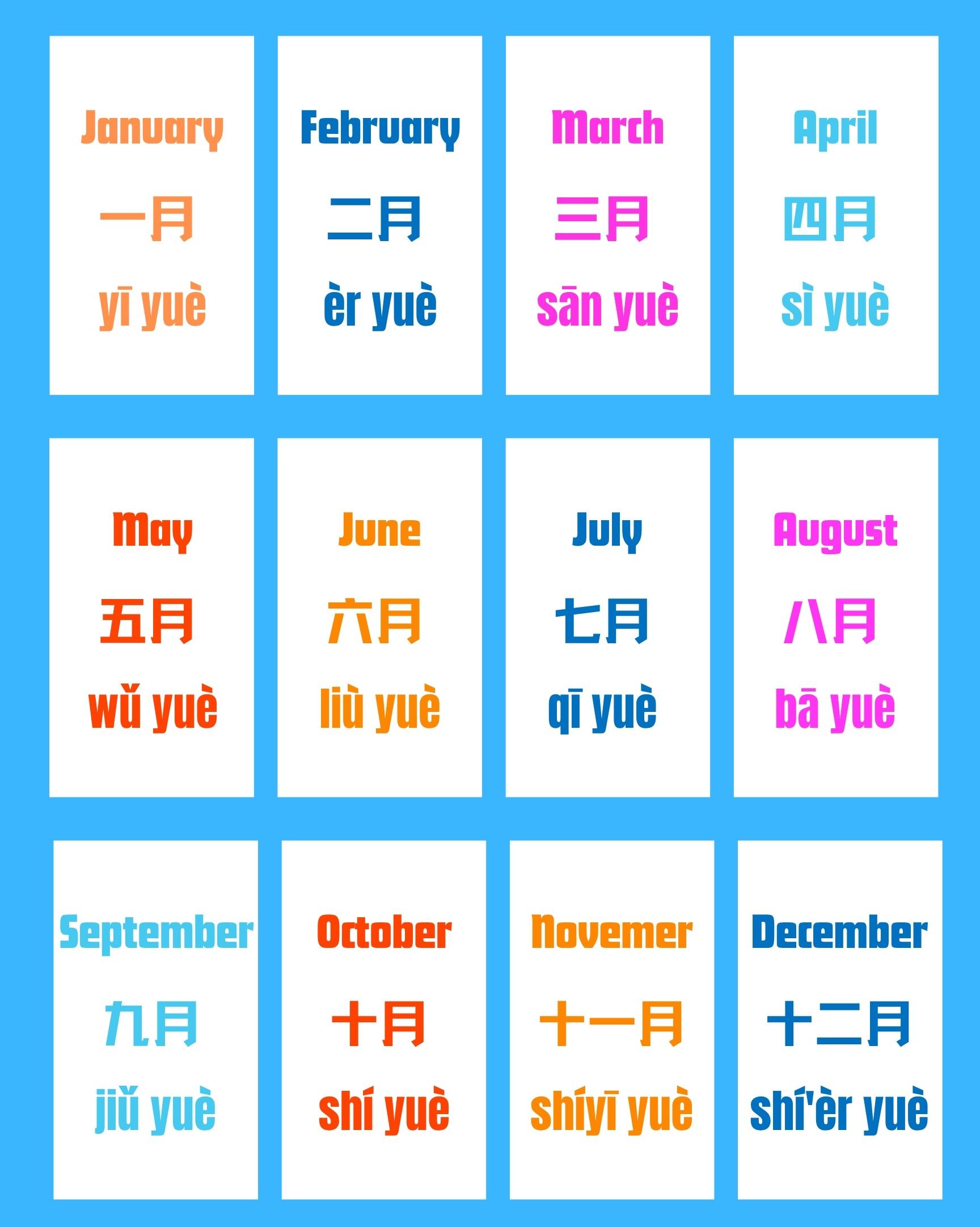
Consider the months of the year. English month names carry traces of history: August, for example, is
named after the Roman emperor Augustus. In Mandarin, the everyday names follow a numerical
pattern: January is yī yuè (“month one”), February is èr yuè (“month two”), and so on.
12 months in Chinese characters and pinyin (picture below)
A child discovering this pattern can begin predicting the names of months they have not yet learned.
They can also ask a bigger question: why do languages name the same things differently?
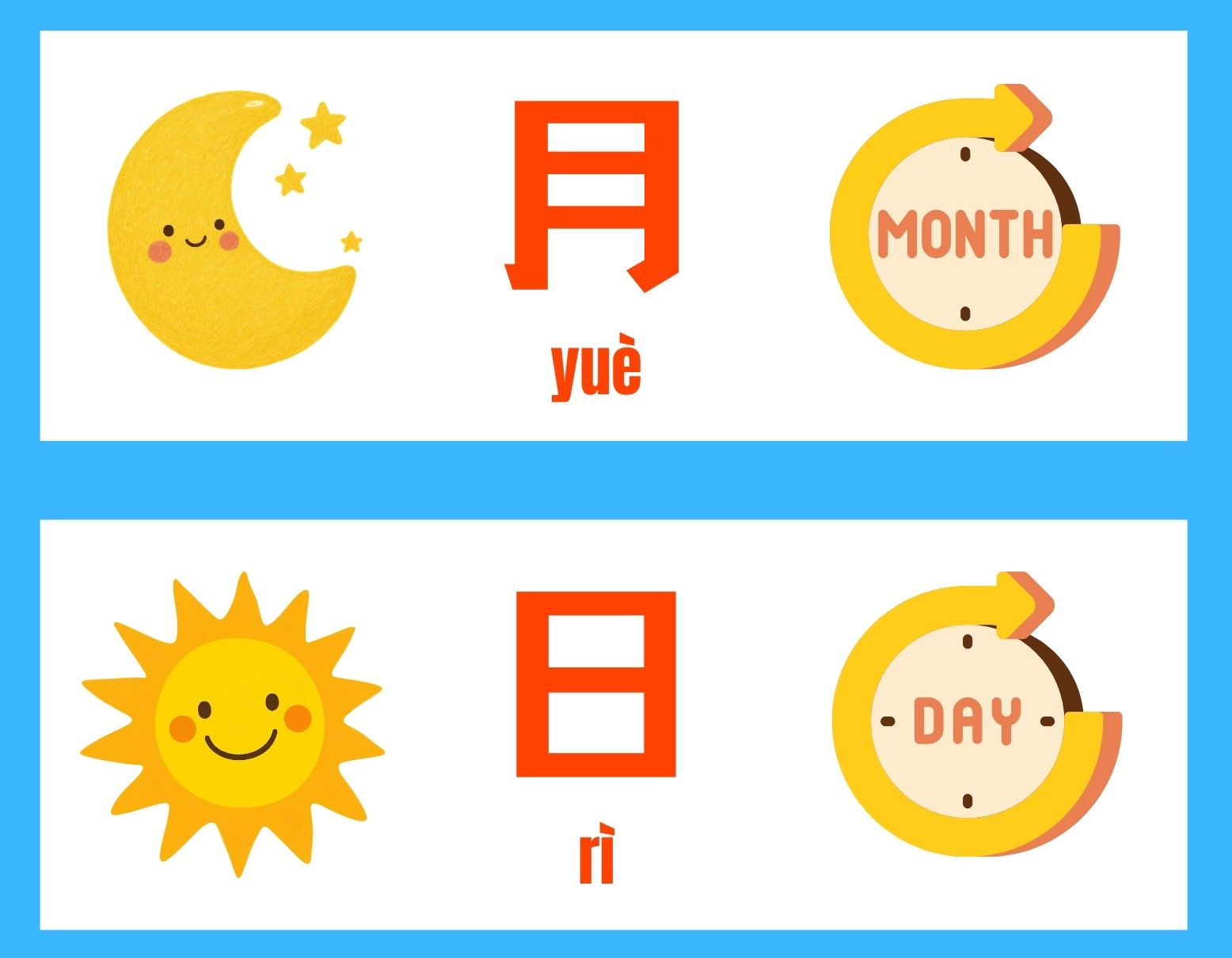
The Chinese character yuè can mean both “moon” and “month,” while rì can mean “sun” and “day.”
These connections offer a starting point for exploring how people have observed the sky and
measured time.
Month and day in Chinese characters and pinyin (picture below)
For a homeschool family, this can become a small project combining language, history, astronomy
and art. Children might design a calendar, investigate a month’s name, or invent names based on the
seasons where they live.
Encountering a familiar concept in an unfamiliar form can spark creative questions. Could we organize it differently? What would we notice if we used another system?
Learning another language does not automatically make someone more open-minded. But exploring
linguistic and cultural differences gives children opportunities to see familiar things in new ways—and
to question the assumption that their first way of understanding something is the only one.
Practicing resilience in a safe environment
Language learning involves moments of uncertainty. A child steps beyond familiar territory: forgetting
a word, confusing a sound, struggling to express a need, or discovering that a sentence does not mean quite what they intended.
These moments can provide practice in trying, receiving feedback, and trying again—when the
environment makes it safe to do so. Resilience does not mean receiving feedback without feeling disappointed or embarrassed. It means gradually learning how to respond to those feelings, seek support, and make another attempt.
An adult’s response matters. We can acknowledge the child’s effort and what they communicated before helping them improve it: “I understood that you wanted the blue one. Let’s try that word together.”
Children also need experiences of progress. Learning a language without much exposure outside lessons can be demanding. A child may understand a word or phrase before feeling ready to use it
independently. Listening, recognizing, and joining in are achievements worth noticing alongside
speaking.
Music, movement, stories, and interactive games can make repetition enjoyable. The aim is to give
children manageable challenges and reasons to keep participating.
Parents do not have to speak the language to support this process. They can ask what their child
enjoyed, invite them to teach a favorite phrase, or help them keep a simple learning journal. A drawing, a remembered word, or a short recording can make progress visible over time. These small routines communicate something valuable: your effort matters, and you do not have to get everything right to keep learning.
Navigating uncertainty
Learning a language asks children to become pattern detectives. Familiar assumptions about words
and sentences may no longer work. Learners need to notice what is happening, test an idea, seek
feedback and adjust.
Take different ways to write an address in English and in Chinese, for example. A typical English-language postal address moves from the recipient and street towards the wider
location. A typical address written in Chinese commonly moves from the broader location towards the
specific destination and recipient.
Sentence structure offers another opportunity to explore ordering.
In English, we might say:
I → cook dinner → at home → six o’clock, evening.
A natural Mandarin version is roughly:
I → evening, six o’clock → at home → cook dinner.
Here, contextual information such as time and place comes before the action. Chinese is not simply
English in reverse, and English also allows different arrangements. The interesting task is to discover what sounds natural in each language.
A learner can notice a pattern, make a prediction, and check whether it works in another example.
Children can practice asking:
What do I notice?
What might the pattern be?
Does it work here too?
What do I need to change?
These “aha” moments give children practice in approaching the same idea through different
structures. Over time, they can become more comfortable setting aside a familiar pattern, considering
an alternative and adjusting how they express themselves.
The process of learning matters
A translation can tell us what someone said, providing an almost immediate result.
Learning a language unfolds over time. We participate, make mistakes, ask questions, and gradually discover other ways of expressing and interpreting experience. Along the way, we may encounter
stories, humor, and traditions that invite us to reconsider our assumptions.
This process can change how we relate to others. Trying to express ourselves with limited words can
remind us to be patient with someone learning our own language. Asking why a phrase matters can open a conversation about another person’s life. Understanding grows through these small
exchanges.
For homeschool families, such experiences need not depend on travel or ambitious learning goals. A library book, a community event, a friendship, or a shared interest can provide a meaningful reason to
learn.
Children may grow up with extraordinary translation tools. They will still benefit from experiences that invite them to listen carefully, tolerate uncertainty, create meaning, and connect. Learning another language can offer a rich place to practice all four.
Author Minji is a children’s Mandarin educator and founder of Creative Chinese Club. She holds an MBA from the University of Cambridge in the UK and a master’s degree in educational technology from the University of British Columbia in Canada.